Backyard Concrete Pads & Infiltration Trenches Guide
Planning a backyard concrete pad or sport court? Learn how stone infiltration trenches help you meet township impervious coverage and drainage requirements.
Backyard Concrete Pads, Drainage Trenches & Township Rules
We recently got a call from a homeowner — let’s call him Mike — who was putting in a concrete pad in his backyard for a basketball court. The concrete contractor was lined up, the grading plan was approved, and then the township added one big condition: a drainage system around the pad.
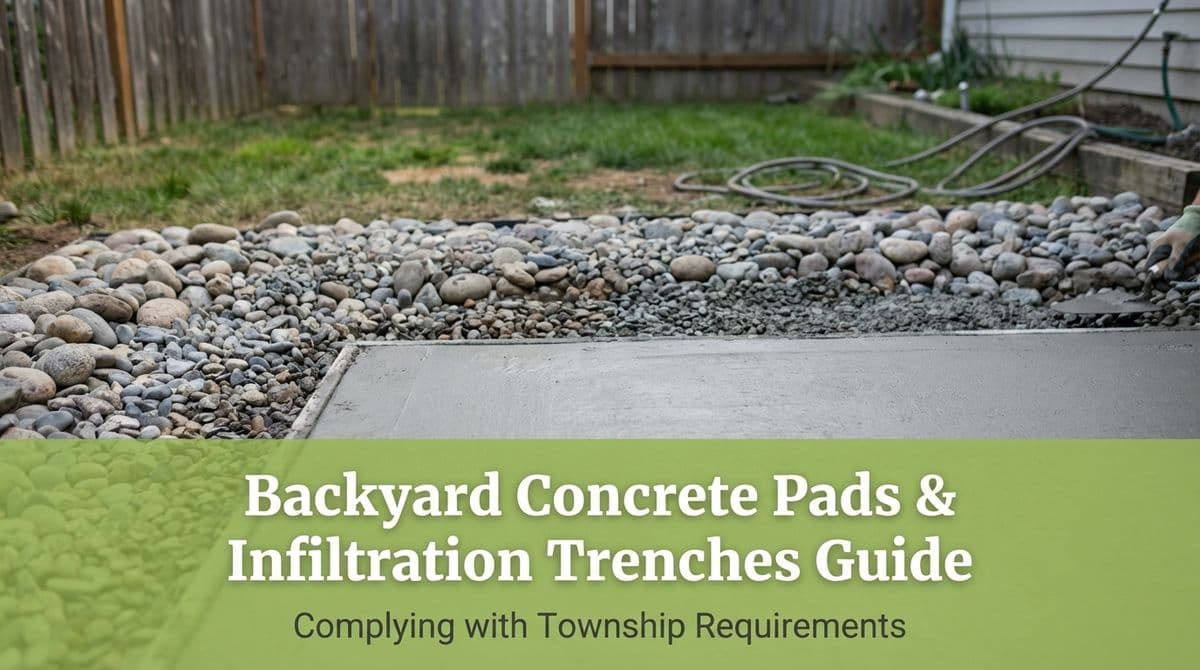
Mike’s township required a stone-filled infiltration trench around the perimeter — about 1 foot wide and 2.5 feet deep, with no outlet pipe. The idea was to capture and soak in the stormwater from the new impervious surface so he could stay within his lot-coverage limits.
If you’re planning a concrete patio, sport court, or backyard pad, you might be getting similar instructions from your township. Let’s walk through why they require this, what an infiltration trench actually is, and how to coordinate it with your concrete work so you stay compliant.
Why Townships Care About Impervious Coverage
Most townships now track how much of your lot is covered by impervious surfaces — things like roofs, driveways, and concrete pads that don’t let water soak into the ground. When you add a large slab in the backyard, you’re changing where rainwater goes.
Too much impervious coverage can:
- Increase runoff into neighboring yards
- Overload storm sewers during heavy rains
- Cause erosion and drainage complaints
That’s why, like in Mike’s case, townships often say, “Sure, you can add the concrete pad — but you need to manage the extra runoff on your own property.” Enter the infiltration trench.
What Is an Infiltration Trench?
An infiltration trench is a narrow, stone-filled trench designed to collect and soak in stormwater. In Mike’s plan, the trench was a simple ring around the pad:
- Width: About 1 foot
- Depth: About 2.5 feet
- Material: Clean, crushed stone
- Outlet pipe: None – water just infiltrates into the soil
Unlike a French drain that might carry water away through a pipe, this type of trench is usually “no outlet” by design. The idea is to provide an underground storage area where water from the concrete pad can sit temporarily and then percolate into the surrounding soil.
How an Infiltration Trench Actually Works
Here’s the basic process when it rains on your new concrete pad:
- Water lands on the pad and runs off, following the slope of the concrete.
- The pad is gently pitched toward the stone trench along the edges.
- Water drops into the stone, filling the void spaces between the rocks.
- Over time, the water seeps out of the trench into the surrounding soil.
The crushed stone has a lot of air space (voids), so it can temporarily store a surprising amount of water. Your engineer or township usually sizes the trench based on:
- The square footage of the pad (Mike’s was roughly 23' x 25')
- Your soil type and how well it drains
- The storm event they want to control (e.g., a 1-inch rain)
Typical Dimensions & Layout Around a Concrete Pad
Every township and engineer is a little different, but for backyard patios and sport courts we often see specs similar to what Mike had:
- Width: 1–2 feet
- Depth: 2–3 feet below finished grade
- Location: Around one or more sides of the pad, often the full perimeter
In Mike’s case, the trench wrapped completely around the pad in a square. Sometimes the design only calls for trenches along one or two “low” sides where water will naturally run off.
Your approval letter or grading plan will usually show:
- The exact width and depth
- The stone type (often clean ¾" crushed stone)
- Any geotextile fabric requirements
- Whether there are inlets (like yard drains) feeding the trench
How We Install an Infiltration Trench Around a Pad
When we help homeowners with this kind of project, our typical installation steps look like this:
- Review the plan. Just like we asked Mike, we always start by reviewing the engineer’s or township’s drawing so we match their specs exactly.
- Mark the layout. Once the concrete location is known, we mark the trench around the pad, following the required dimensions.
- Excavate. We dig the trench to the specified width and depth, keeping sidewalls as stable as possible.
- Install fabric (if required). Some townships want a geotextile liner to keep soil from clogging the stone.
- Fill with clean stone. We bring in the specified crushed stone and compact it in lifts so it’s stable but still has plenty of void space.
- Finish the surface. Depending on your plan, the stone may be left exposed, topped with a thin layer of soil, or covered with turf or mulch.
Concrete vs. Drainage: Which Comes First?
This is the big timing question Mike had: should the concrete be poured before or after the trench is installed?
In most backyard projects, it’s easier and more accurate to do what Mike wanted to do:
- Step 1: Install and finish the concrete pad.
- Step 2: Dig and build the trench around the finished pad.
Doing the concrete first means:
- You know the pad’s exact size and location.
- You can match the trench to the actual perimeter, not just a drawing.
- You avoid damaging a finished trench with concrete trucks or equipment.
That said, some townships or engineers may have a specific sequence they prefer, so it’s always smart to double-check the approval notes.
Staying Compliant With Lot Coverage Rules
If your project has already pushed you over your impervious limit — like Mike being about 10% over — the infiltration trench is usually not optional. It’s the condition that allowed your township or board to approve the extra coverage.
To stay compliant:
- Follow the plan. Match the trench depth, width, and materials exactly.
- Keep documentation. Save the engineer’s plan and any photos of the trench during installation.
- Schedule an inspection. Many townships want to see the trench before it’s fully covered.
- Maintain it. Keep the trench area free of sediment buildup and heavy compaction so water can still infiltrate.
Need Help With Your Backyard Concrete Drainage?
If your township is requiring a stone infiltration trench around a new concrete patio, sport court, or pad, we can walk you through the details, review your engineer’s plan, and install the system to match the specs.
Every property and township is a little different, but with the right layout and timing between the concrete work and drainage installation, you can enjoy your new backyard space and stay on the right side of the impervious coverage rules.